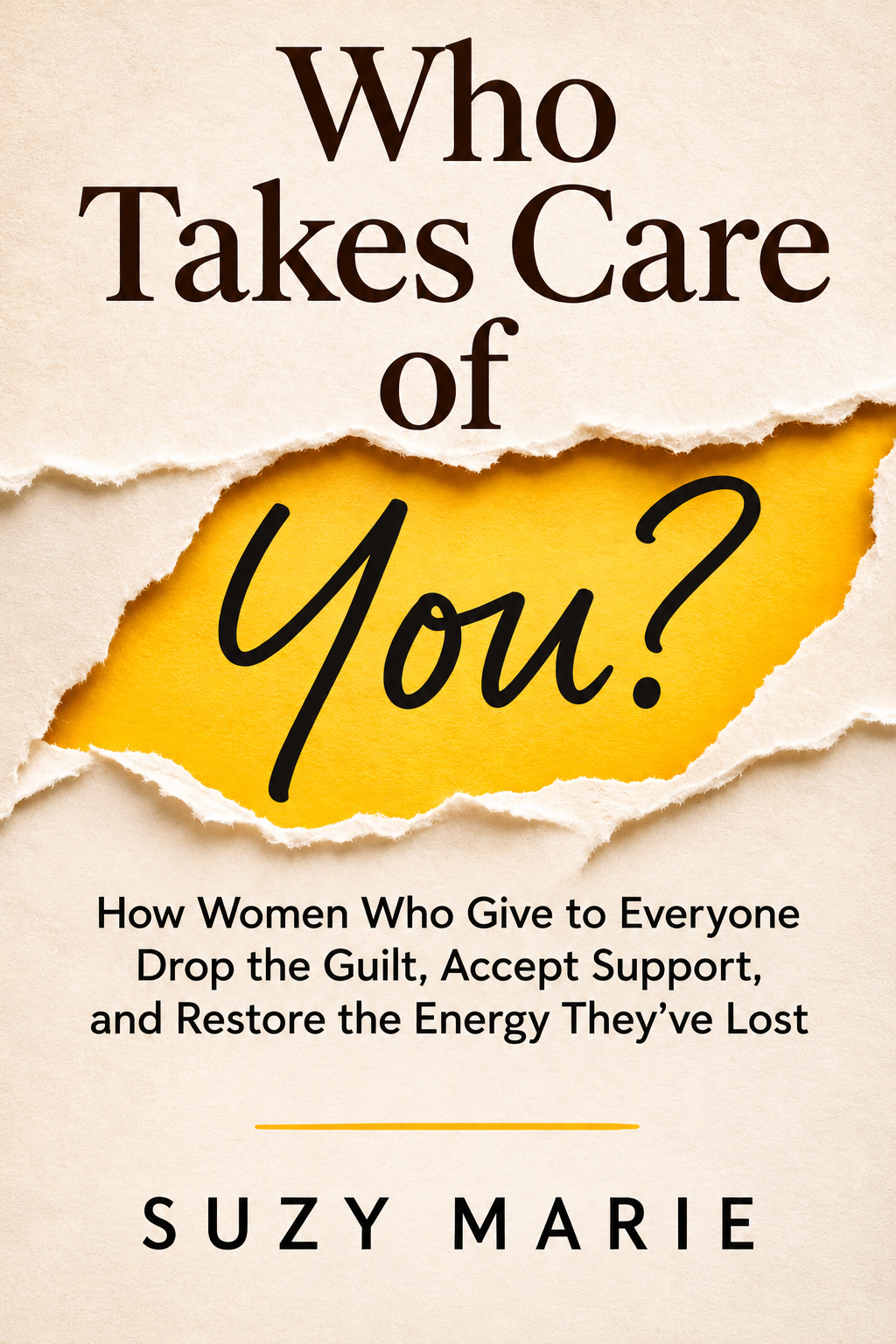
Who Takes Care of You?
For the woman everyone counts on

For the Woman Everyone Counts On:
It’s Time You Became One of the People You Show Up For 

You’ve been the glue for so long that your own needs barely register anymore. Who Takes Care of You? shows you how to make room for yourself again, keep loving your people fiercely and stop feeling like you have to earn every minute of rest.

Yes! Rush me a copy — $20
✓ 30-day money-back guarantee
Ebook only · Instant download

What it's like to be the one everyone calls

You're the one who remembers the dentist appointments, answers the message before your first full breath, and says "of course" while something in your chest tightens.

She wakes before the house does, hoping for a few quiet minutes. They go to email, then lunches, then the list of everything that has to happen before dinner. Nobody has asked her for anything yet, and she's already giving.

Maybe you know her. Lunch is whatever's left on the kids' plates at three, eaten standing up. "I'm fine," you say, and the dishwasher door shuts harder than it needed to. The only hour that feels like yours comes after midnight, spent scrolling, and you pay for it at six.

Underneath it all, a few sentences run on repeat:

"Once things calm down, I'll start."

"I should be able to figure this out on my own."

"It's easier if I just do it myself."

If any of that sounds familiar, you're not alone, and you're not broken.
Why being the reliable one can make you disappear

People say it with real warmth. I don't know how you do it. You're so strong. What would we do without you.

I call this the Reliability Prison. The woman everyone counts on gets praised for the very thing that is making her disappear. The bars look like being a good mother, a good partner, a responsible adult.

Nobody forced you in. You walked in because it was warm, and the door locked behind you with a compliment.

Why understanding your pattern hasn't stopped you saying yes to everyone

The usual belief goes like this: once you understand why you overgive, you'll stop.

It's a reasonable thing to believe. You've probably done the reading, maybe years of therapy. You could trace your yes back to the kitchen you grew up in and explain it to a stranger at a party. That insight took real work, and it counts for something.

The yes doesn't come from the part of you that understands, though. It comes from the body. Your stomach clenches, your shoulders rise an inch, and your mouth says "sure" a breath later. A body that learned early that needing things was risky won't change its mind because you read a good paragraph about attachment.

Insight and embodied change are two separate jobs. Plenty of capable women have finished the first without the second ever starting. Nothing about that is a personal failure.

Why retreats, courses and morning routines fade by week two

I built one of these myself. My cohost and I brought eighteen women to Orvieto, in the Italian hills, and eight more to Chacala, on the Pacific coast of Mexico. One woman told me she felt more seen and held that week than she ever had in her life.

Then she flew home to the same kitchen and the same bedtimes. So did I, to depleted finances and a burnout that had been waiting patiently for me. A retreat can give you a peak. It can't give you practice at home, inside the life that made the pattern in the first place.

The rest of the list looks the same. Therapy gave insight without embodiment. Solo yoga brought relief that vanished the first busy month. The online course stalled at module three and left a small flinch of guilt every time the next email arrived. The habit tracker held until a sick kid broke the streak.

Most of these asked you to do more, by yourself, using the same capable part of you that got you here. The overgiver took the course. The overgiver kept the streak.

The women who came before us had aunts at the stove and a neighbor who would take the baby for an hour without being asked. You've been trying to carry alone what was always meant to be carried together, and then grading yourself on the result.

Why I wrote this book

I'm writing from the ground, and the ground was a single mom's kitchen. The income shrank a little more every month, and the tiredness living there didn't lift after a weekend. From the outside I looked like someone who had it together.

I was a latchkey kid. A child who lets herself into an empty house learns to read a room before she enters it and gets very good at being easy. At eight, a friend told me she felt better just from me listening, and that I should be her therapist. I didn't know what a therapist was. I've spent most of my life trying to do that same thing on purpose.

In my twenties I kept a house and raised my partner's children, sure that being needed and being loved were the same thing. Motherhood is where I first saw my patterns running in real time. I was giving and giving and had no idea how to receive.

For years I managed it three ways. I knew everything about my patterns. I quietly waited for someone to arrive with a wand. And I pushed. Then all three wore out at roughly the same time, and I was left with the one thing I'd never tried: staying. Feet on the floor, noticing what was there.

That's when it landed. No one could save me, and I was never meant to do this alone. Both were true at once, and the second half is why this book exists.

Why letting others care for you gets easier once your body feels safe

When you practice staying with the tightening, without explaining it away or outrunning it, being cared for slowly stops feeling like a threat.

A healthy root drinks from the soil. A braced root grips, holding the tree upright through tension, and from outside the tree looks strong. It can stand like that for years. It just goes dry.

Some women tense up the moment attention turns their way. Giving feels familiar, even restful. Receiving brings the bracing straight back, because being useful has been how they keep their place.

Patterns learned in relationship loosen in relationship, through experience repeated. You have a need and nobody leaves. You disappoint someone and the love is still there. Once is interesting. Twenty times, in your real week, begins to be believed.

The Tree of Devoted

This book pairs a short daily practice of meditation and movement with an honest, shame-free look at where the habit of constant giving began. Each layer is designed to hold before the next one builds on it, so the work starts with the body that braces rather than the overfull calendar sitting on top of it.

01
Tend the Soil
You get clear on what actually matters this season so you can protect sleep, real food, movement and a few quiet minutes before the phone. Devotion, not decoration.
02
Settle the Roots
You learn to notice where tension lives in the body, whether that is the chest, jaw or gut, and how to settle it with feet on the floor, slow breath and guided movement.
03
Strengthen the Trunk
You look at the pattern of overgiving clearly and without shame, and practice holding love and resentment in the same sentence so neither one disappears.
04
Open the Branches
You practice naming one need out loud and letting someone meet it, while keeping full say over how that happens.
05
Reach for the Sky
You build a connection to something larger than the to-do list, on your own terms, and decide in advance what will bring you back after you drift.
Yes! Rush me a copy — $20
Instant download

What Others Are Saying

"I came in sure I was broken. I left understanding I wasn't."

— A coaching client

"It felt like someone walking beside me. Nobody was trying to fix me."

— A coaching client

"I felt more seen and held this week than I ever have in my life."

— A retreat guest in Chacala, Mexico

How one client learned to let care in

I'll call her Sarah. She arrived invested and clear about why she'd come. A few sessions in, she started struggling to show up, because looking at what she hadn't been given growing up was too much to hold. She loves her family. She keeps those relationships. Both of those had to stay true at once.

What brought her back wasn't a tool. In one session she noticed herself becoming activated, that familiar rise, and then felt herself shift out of it, with someone across from her and nobody fixing anything. The work stopped being a story about her childhood and became something her body had just done. She completed twelve weeks with me. She still comes.

What You'll Be Able to Do After Reading

01
Spot the four sensible reasons so many women put themselves last
Waiting for calm, handling it alone, knowing why, and "it wasn't that bad." The book shows how each one earns praise while keeping a person hidden, so the pattern finally becomes visible and workable.
02
Understand why insight alone hasn't changed the pattern yet
The book explains what the body needs before understanding can reach what a person actually does, and gives a step-by-step way to close that gap.
03
Catch the three quiet ways of leaving yourself behind
Knowing without acting, waiting to be rescued, and pushing through. The book names what is left once all three wear out, and shows what to build instead.
04
See clearly what each previous approach left unfinished
A plain look at therapy, books, retreats and trackers, including what I call Fix-Yourself Wellness: care that is really the old demand to do more in softer clothes. Naming the gap makes room for something that actually holds.
05
Understand why receiving care feels uncomfortable and learn to stay with it
Braced Roots is my name for the tightening that arrives with attention. The book walks through why it happens and builds the capacity to let care actually land.
06
Look at where the pattern began without blame landing on anyone
Swapping "but" for "and" opens the story without collapsing it. The book also explains titration and pendulation in plain words: small doses of what is hard, with steady ground nearby to return to.
07
Start a morning practice that fits inside five minutes
The book shows why the minutes before the phone matter most, and gives a line-by-line reply to the voice that says "I'll start Monday for real."
08
Catch the automatic yes before it leaves your mouth
The book teaches how to feel the clench, say "not this week" without an apology stapled to the back, and what to do in the ten breaths that follow.
09
Let help land without feeling the need to pay it back by dinner
The book names the quick, polite reflexes that hand care back before it reaches you, and offers one small, concrete ask to try this week.
10
Know exactly what to do the first time you skip your practice
Five questions show which layer gave way, and a forty-eight-hour plan makes coming back straightforward, without a verdict against yourself.

Is This Right For You?

This is NOT for those who:
  • Want a seven-day reset and a new self by Friday.
  • Want to be told exactly what to do so they can do it perfectly.
  • Are mainly hoping a partner or mother will finally change.
  • Want productivity tips so they can fit even more into the week.
This is for the woman who:
  • Is the glue at home and the dependable one at work.
  • Loves her people fiercely, resents them sometimes, and feels terrible about the resenting.
  • Has something in her that's ready to go slower than she ever has.
  • Wants to let herself be one of the people she's reliable to.
Yes! Rush me a copy — $20
Instant download

Frequently Asked Questions

Is this just another self-care book?
No bath bombs, and no thirty-day plan at the back. You're probably good at plans already. This book asks for smaller things than a plan and gives you a way to come back after you skip them.
Do I need meditation or yoga experience?
None. The practices begin with feet on the floor and a few slow breaths. Prayer counts. So does coffee held in both hands with your eyes on the window.
How quickly will I notice a difference?
I won't promise a date, because I've never seen deep patterns reorganize on a schedule. What many women notice first is small: a pause before the yes where there used to be a reflex. The needle moves from there, mostly through returning.
What if I truly don't have twenty minutes in the morning?
Five counts. I mean that. A practice that fits five minutes on a hard day will serve you better than a forty-minute ritual you feel guilty about.
Is this therapy?
No. I'm a coach, and the book is honest about that. If you're in crisis or need clinical care, it asks you to reach licensed help first. Coaching can sit alongside that care. It never replaces it.
Will the book try to sell me something?
Inside, you'll find an invitation to a free thirty-minute conversation with me, the Coming Home Call, if you'd like a real person to listen. There's no pitch. If something else would serve you better, I'll tell you so.
Suzy Marie

Suzy Marie.

I'm an integrative mental health coach, a graduate student of psychology, and a trauma- and attachment-informed psychosomatic practitioner. I'm also a yoga instructor, herbalist and astrologer. I work with women standing at thresholds: new motherhood, midlife, breakups, empty nesting and career upheaval.

The moment that shaped my work most was becoming a mother, and realizing nobody was coming to save me. I can't save anyone either. What I can do is walk alongside you, listen first, and help you sort out how to move forward. We've lost the village. I'd like to give some of that holding back.

Come home to yourself

Stop putting yourself last
and let care
reach you too

Small daily practices for the body and a simple five-layer map, so you can feel like yourself again while still loving the people who count on you.

Yes! Rush me a copy — $20
30-day refund · Ebook only · Instant download